3 Shocking Secrets That Can Make Water Filter Certifications Misleading
What every consumer should know before trusting a certified water filter.
Walk into any home improvement store or search online for a water filter and you’ll quickly discover hundreds of options. From simple faucet-mounted filters and under-sink systems to sophisticated whole-house treatment units, the choices seem endless.
Unfortunately, so are the marketing claims.
One manufacturer promises cleaner water. Another promises healthier water. Others advertise removal of dozens—or even hundreds—of contaminants. For the average consumer, separating fact from marketing can become almost impossible.
This is where most people turn to water filter certifications.
Organizations such as NSF, IAPMO, and the Water Quality Association (WQA) provide certifications that are intended to verify a filter’s performance. To many consumers, seeing one of these certification marks creates confidence that the product has been thoroughly vetted. But certifications don’t always tell the complete story.
Understanding what a certification does—and just as importantly, what it doesn’t do—can help you make a far more informed purchasing decision.
Secret #1: Manufacturers Pay for Their Own Certifications
One of the biggest surprises for many consumers is that water filter certifications are not issued by a government agency.
The organizations that perform certification testing are independent private organizations, and manufacturers voluntarily submit their products for testing and pay the associated fees.
This arrangement does not automatically mean the testing is inaccurate or dishonest. Reputable certification organizations have established testing protocols designed to maintain their credibility.
However, it does create a system in which the manufacturer is the customer.
That reality naturally raises questions that many consumers never consider:
- Who decides what gets tested?
- Who pays for repeated testing?
- How much influence does the manufacturer have over the certification process?
Even if every certification organization operates with complete integrity, transparency is essential whenever financial relationships exist.
Consumers deserve to understand how the system works before assuming a certification is equivalent to government approval.
Secret #2: Certifications Only Verify What the Manufacturer Chooses to Test
Perhaps the most misunderstood aspect of water filter certifications is their scope.
A certification does not necessarily describe everything a filter can remove—or everything it cannot remove. Instead, certifications generally apply only to the specific contaminants, and performance claims the manufacturer chooses to have evaluated. Different certifications can cause confusions as we see below.
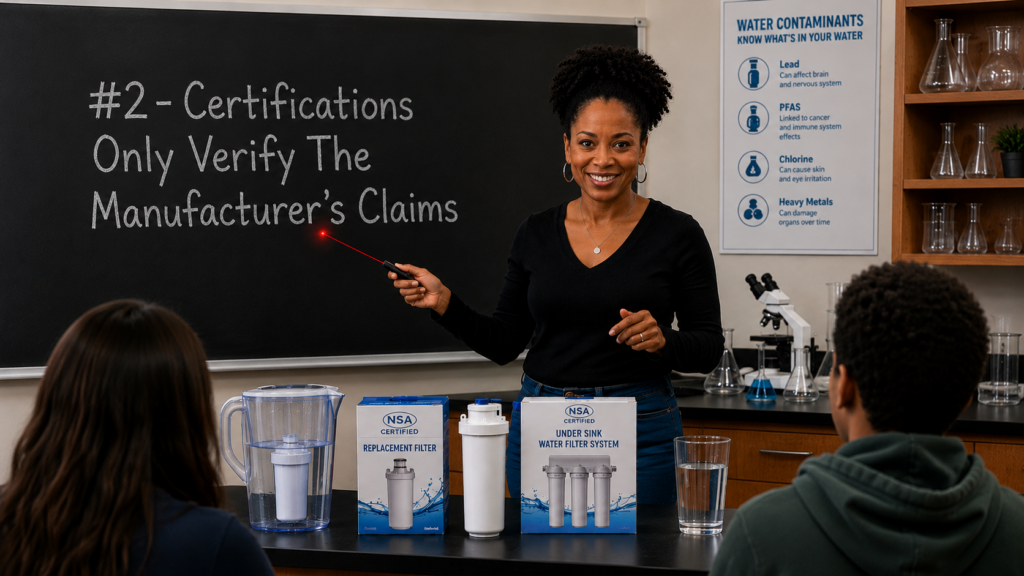
Standard-Specific Limitations: A badge for NSF/ANSI 42 only guarantees aesthetic improvements (like chlorine reduction and basic particulates). It does not mean the filter removes heavy metals. For health-related contaminants (like lead, VOCs, or PFAS), you need NSF/ANSI 53.1
For example, if a manufacturer wants to certify lead reduction, the testing will focus on lead.
If they want certification for PFAS reduction, separate testing is typically required.
If they choose not to pursue certification for a contaminant—even if the filter may reduce it—the certification won’t mention it.
Likewise, a certification only verifies performance to the level required by the applicable standard or claim being evaluated.
This can create confusion because consumers often assume that a certified filter has been comprehensively tested against every major drinking water contaminant.
That simply isn’t how the certification process works.
A good real-world example is countertop pitcher filters. Some models have demonstrated significant PFAS reduction, yet their marketing and certifications may emphasize taste, odor, chlorine, or heavy metal reduction because those were the claims the manufacturer chose to certify.
As a result, consumers may purchase an additional filter unnecessarily—or overlook a filter that might otherwise meet their needs.
In my opinion, manufacturers should provide consumers with far more complete performance information. At a minimum, buyers should have access to comprehensive testing results for a broad range of contaminants rather than only a selected list of certified claims.
Secret #3: No Certification Guarantees Safe Drinking Water
This may be the most important point in this entire article.
No matter how many certification marks appear on a water filter box, no certification guarantees that the water coming from your tap will always meet every definition of “safe drinking water.”
Why?
Because drinking water quality depends on far more than the filter itself.
Variables include:
- The quality of the incoming water
- The concentration of contaminants
- Proper installation
- Routine filter replacement
- Flow rate
- Water chemistry
- Contaminants that the filter was never designed to remove
A filter can be highly effective at reducing certain contaminants while doing little or nothing for others. That doesn’t make it a bad filter. It simply means every filtration technology has limitations.
I believe manufacturers should make those limitations far more visible to consumers.
A certification should be viewed as evidence that a filter has demonstrated performance under specific testing conditions—not as a blanket guarantee that every glass of water will be completely safe under every circumstance.
Bonus: The “Dirty Little Secret”
Many consumers assume that every filter coming off the production line is independently tested after certification. That is generally not how product certification works.
Certification programs typically involve initial qualification testing along with ongoing quality assurance requirements established by the certifying organization. However, consumers often don’t realize that each individual filter sold retail is not necessarily performance-tested before reaching store shelves.
For that reason, manufacturing quality control remains critically important.
Consumers should understand that a certification reflects compliance with a certification program—not necessarily individual testing of every filter they purchase.
The Bottom Line
Water filter certifications absolutely have value. They provide standardized methods for evaluating product performance and help eliminate many unsupported marketing claims.
But certifications are not the same as guarantees. They should be viewed as one important piece of information—not the only piece.
As contamination challenges continue to evolve—with PFAS, pharmaceuticals, microplastics, industrial chemicals, and aging water infrastructure becoming increasingly significant—consumers deserve more comprehensive information than ever before.
I believe the future of water filtration should include greater transparency, broader contaminant testing, and clearer communication about what filters can and cannot do.
An informed consumer is far better protected than one who simply trusts the logo on the box.
CHECK US OUT ON YOUTUBE https://youtu.be/d6E7UHcpIAs