
In my hometown of Memphis and in other cities across the globe communities are finding themselves in a pickle regarding the use of fresh city water versus recycled industrial water, commonly called gray water. To the untrained observer using grey water versus city resources seem to be a no-brainer. Save the city water, right? Not so fast!
There are some dastardly secrets about water use and super computers that escape most municipalities until it is far too late. Let’s look at these bugaboos one by one.
- Many times, and this was the case in Memphis with xAI, the owner will initially commit to using municipal gray water. Oh, my goodness the hidden caveats are just oozing out. What municipalities fail to realize is that when they open a super-computer site the owner already has phase II and phase III drawn up and ready to go. The unsuspecting municipality, overjoyed about protecting its’ local drinking water supply, intoxicatingly celebrates being environmentally conscious with water reuse. The problem? While in general, the amount of gray water requested for the initial plant is within the reach of the locals to supply, before the first grey water infrastructure is ever built, the new phases may ask for 5X that volume or even more. In most cases, the municipality doesn’t have the resources to supply that much gray water and the super-computer winds up using the local tap water. The design engineers knew this going in. The publicly expressed willingness to use grey water? It is just a ruse to make citizens believe the plant is water friendly.
- The belief that it is environmentally better to use grey water instead of tap water is flawed. While technically called a closed loop cooling system, these systems are not closed to the environment. Let’s consider how a closed loop system really works. Fresh gray water is pumped into the loop. This water requires a lot of chemical addition so that it is usable. Antiscalant, Anticorrosive, Defoamer, Coolant, and Bacteriocide are continually added to achive the proper cooling water quality. These chemicals are eventually released back into the local environment, and muse be diluted with fresh city water so they can be treated and released into the environment.
- When the cooling water runs through the computer chambers it heats up. That heat must be dissipated if the cooling water is able to be reused. Otherwise, the water would keep heating up and destroy the computer. So, how does a cooling loop dissipate heat? It uses a cooling tower. In the cooling tower the hot water trickles down through plates and the air passing by cools the water. Sounds good right? Well, here is the thing. xAI Memphis asked for an initial 2 million gallons of fresh water per day. If this is a closed loop why do they need 2-million gallons every day? Well, it is because when the hot loop water hits the cooling tower, great evaporation occurs. The evaporation must be replaced by new water. But hey, that is wastewater so it saves pulling from the local aquifer, right? Not so fast!
- In science all equations, reactions, and processes must achieve mass balance and energy balance. In other words, what goes in, must come out. 1+1 = 2. So, examine the case before xAI came to Memphis. The 2-million gallons of gray water simply got treated and sent into the eco system. Dirty, yes, but it contributes to maintaining the local water table. Conversely, after xAI 2 million gallons of gray water gets evaporated and sent to other places to contribute to other water tables. So, xAI just calls for 2-million more gallons of gray water, right? Well, where does that water come from? It comes from the aquifer, or the associated local municipal water system. It comes indirectly, but the gray water still comes from the local water supply.
- Another dirty little secret about closed loop cooling systems is something called blowdown. Those chemicals that were constantly added to the incoming grey water? Well, as the cooling tower evaporates water, the concentration of chemicals and impurities in the gray water constantly increases. At some point the concentration of contaminants is so high, the cooling loop has to be flushed to the drain, and voila, a so-called environmentally friendly process, sends pollution into the local environment.
- To make things even more fishy, the cooling tower blowdown can be thick and sludge-like. That means the plant will use fresh municipal (aquifer) water to dilute it, allowing it to pass down the drain. Still think we save water with closed loop gray water-cooling systems? Maybe not so much, eh?
- Finally, gray water has every known manner of nasty chemical and biological contaminant in it. Legionella is an infamous cooling tower organism. God only knows what else can grow up there. Always remember, bacteria and viruses, which are much smaller than pollen, are very much a part of the air we breath. Would I want a gray water cooling tower near my home? Please, do mankind a favor, let’s use fresh city water.
The drawings below will help the reader to understand how a closed loop cooling system works.
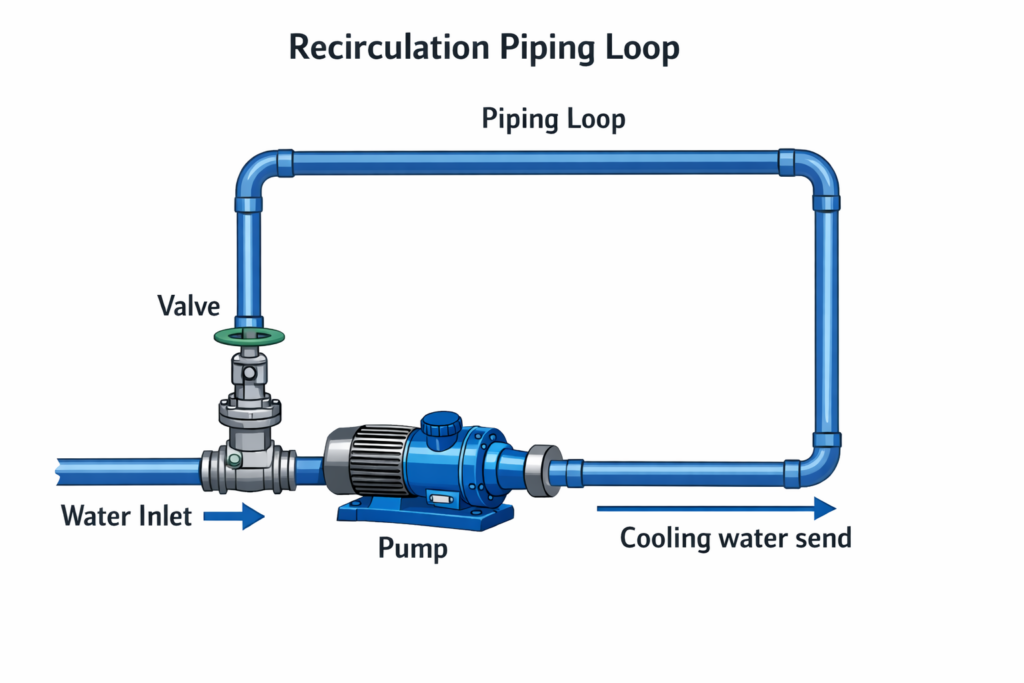
Figure 1.
This is what most people think of when they hear the term, ‘closed loop cooling system. This is a happy little system like a car radiator where the water circulates happily forever.
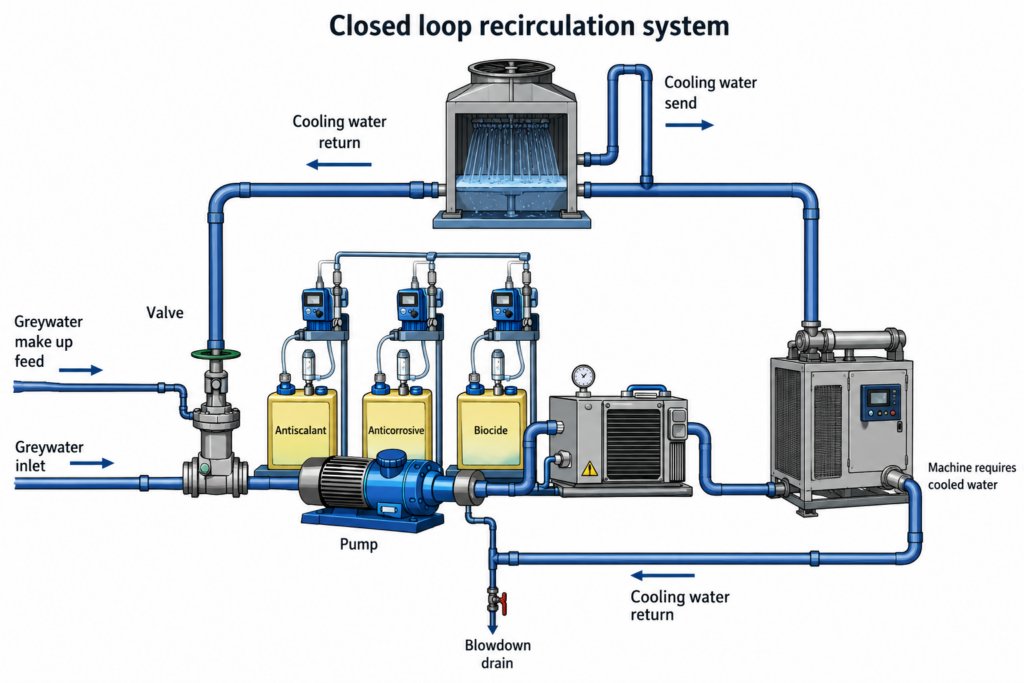
Figure 2.
This is what a true closed loop cooling system looks like. Complete with chemical injection and evaporative cooling tower.
The takeaway with super computer installations, and really any type of industrial/manufacturing plant, is that local governments must have individuals with a high level of engineering, chemistry, biology and process expertise in place before they can make decisions on whether or not a new plant is suitable for their community.