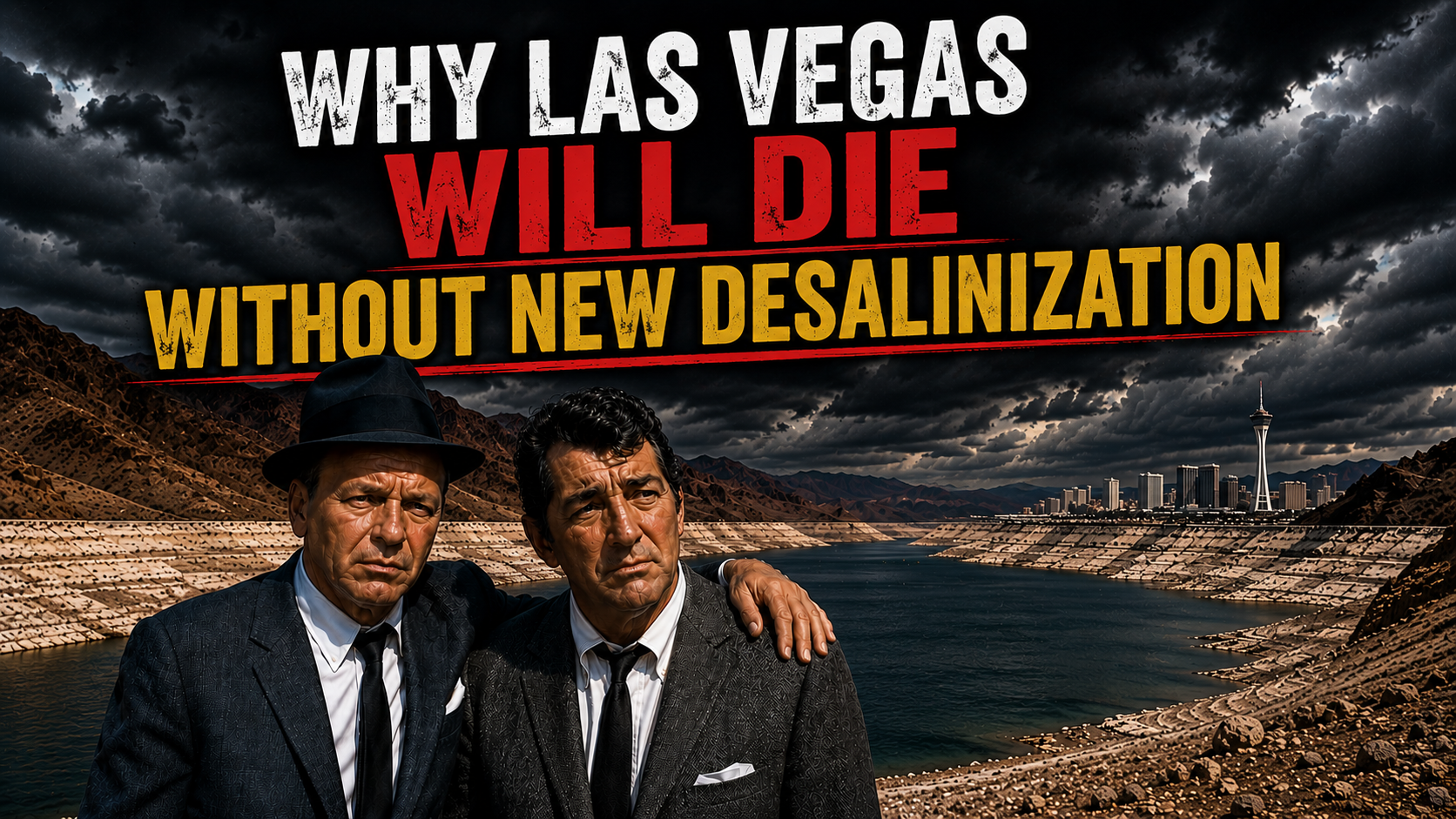
Las Vegas has accomplished something remarkable: it built one of America’s fastest-growing metropolitan areas in the middle of the Mojave Desert.
But there is one resource Las Vegas cannot manufacture, conserve or recycle indefinitely: new water.
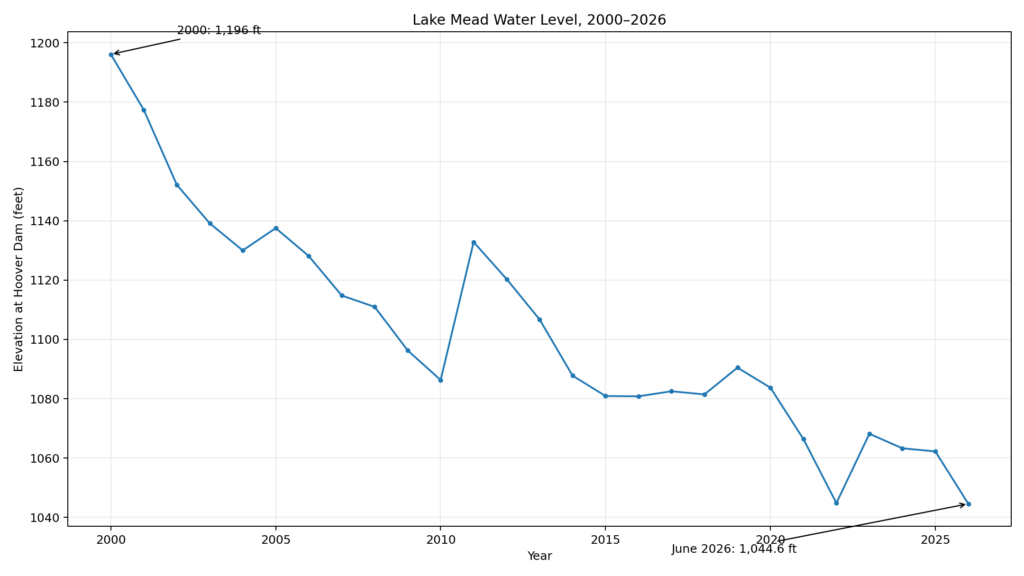
Southern Nevada depends heavily on the Colorado River and Lake Mead, and the warning signs have been visible for decades. Bureau of Reclamation records show Lake Mead at approximately 1,196 feet above sea level at the end of 2000. By June 2026, it had fallen to about 1,045 feet—a decline of more than 150 feet.
The problem isn’t simply drought. It is arithmetic. More people are living and working in one of the driest regions of America, while the river system supporting them is under increasing pressure.
Southern Nevada has responded aggressively. Water conservation has reduced per-capita consumption by 58 percent between 2002 and 2025, even while the area’s population increased by approximately 876,000 people. Nearly all indoor water used in Southern Nevada is also treated and returned to Lake Mead, allowing it to be recycled through the Colorado River system.
Those are impressive accomplishments. But conservation doesn’t create a new water source.
Imagine 250 Million Gallons A Day
Consider a future supplemental water supply on the order of 250 million gallons per day.
That sounds almost unimaginably large, but hydraulically it can be put into perspective: approximately that magnitude of flow could be transported through a major pipeline roughly 48 inches in diameter, depending on the design velocity and pumping conditions.
The question America should be asking is: Where could that new water come from?
There is one source so large that, from a human water supply perspective, it is effectively limitless.
The ocean.
Seawater desalination has already demonstrated that cities do not have to depend entirely upon rainfall, rivers and shrinking reservoirs. The Pacific Ocean could become part of a larger regional water strategy in which desalinated coastal water offsets freshwater currently transported inland, allowing Colorado River water to be redirected or exchanged to benefit communities such as Las Vegas.
Desalination, however, comes with an enormous catch.
The Salt Problem Nobody Talks About
Seawater contains roughly 3.5 percent dissolved salts. NASA notes that sodium chloride alone averages about 2.6 percent of seawater by weight.
Process 250 million gallons of seawater every day, and the amount of dissolved mineral salts involved is staggering—on the order of 75 million pounds per day, depending on salinity.
That is approximately 27.4 billion pounds—or 13.7 million tons—per year.
If that material were separated into solids and transported in trucks carrying approximately 50,000 pounds each, it would represent roughly 1,500 semi-trailer loads every day—or about 45,000 truckloads every month.
And that exposes one of desalination’s biggest challenges. Where does all that salt go?
Conventional coastal desalination plants generally don’t crystallize all those salts and haul them away. They discharge concentrated brine back to the ocean under carefully engineered and regulated conditions. But if desalination is moved inland, the problem becomes considerably more difficult.
Evaporation ponds require land. Deep-well disposal has geological and regulatory limitations. Zero-liquid-discharge technologies require additional energy and equipment. Crystallizing, storing and transporting salt creates another enormous infrastructure problem.
Moving seawater or desalinated water hundreds of miles inland also requires pipelines, pumping stations and enormous amounts of energy.
Desalination is not magic. But neither is conservation.
Lake Mead Is Sending Us A Warning! (Historical Lake Mead Water Elevation)
2000 — approximately 1,196 feet
2005 — approximately 1,138 feet
2010 — approximately 1,086 feet
2015 — approximately 1,081 feet
2020 — approximately 1,084 feet
2022 — approximately 1,045 feet
2025 — approximately 1,062 feet
June 2026 — approximately 1,045 feet
Who’s Next?
Source: U.S. Bureau of Reclamation, Lake Mead at Hoover Dam end-of-month elevations.
The trend should concern anyone responsible for the future of the American West.
Desalination is not the end-all answer to Las Vegas’s water problems. It is expensive, energy intensive and creates difficult brine-management problems.
But it is also a proven technology capable of creating something conservation alone cannot:
A new supply of freshwater.
The Pacific Ocean represents an enormous potential water resource sitting beside some of the most water-stressed regions in the United States. America should be developing the infrastructure, energy systems, water exchanges and desalination technologies necessary to take advantage of it.
America Needs A National Water Plan
Our biggest problem may not be a lack of technology; it may be a lack of long-term planning.
America has no comprehensive national strategy for moving water from water-rich regions and sources toward areas facing potentially catastrophic shortages. We continue treating water primarily as a local problem even though the Colorado River supports multiple states, enormous agricultural regions and some of America’s largest cities.
That approach is becoming increasingly dangerous.
We need a National Water Plan that examines desalination, water recycling, interstate water exchanges, pipelines, aquifer management, conservation and new technologies as pieces of one interconnected system.
And America should consider creating a National Water Czar with the authority and responsibility to make water security a national priority.
Las Vegas isn’t going to disappear tomorrow.
But Lake Mead is giving us a warning about what happens when population growth, limited freshwater supplies and decades of inadequate national planning collide.
The ocean contains the water. We have the technology.
What America lacks is a plan.
For More Info, Check Out My YouTube Video https://www.youtube.com/watch?v=IHKJlcPpaHU