
Biochar has become one of the hottest topics in agriculture, water treatment, carbon sequestration, and environmental sustainability. Investors, entrepreneurs, municipalities, and farmers are pouring millions of dollars into biochar projects, believing they have found the next revolutionary material.
On paper, the opportunity looks almost unlimited. Biochar promises improved soil fertility, carbon credits, water purification, odor control, livestock applications, and even advanced filtration technologies. Unfortunately, the reality is far more complicated.
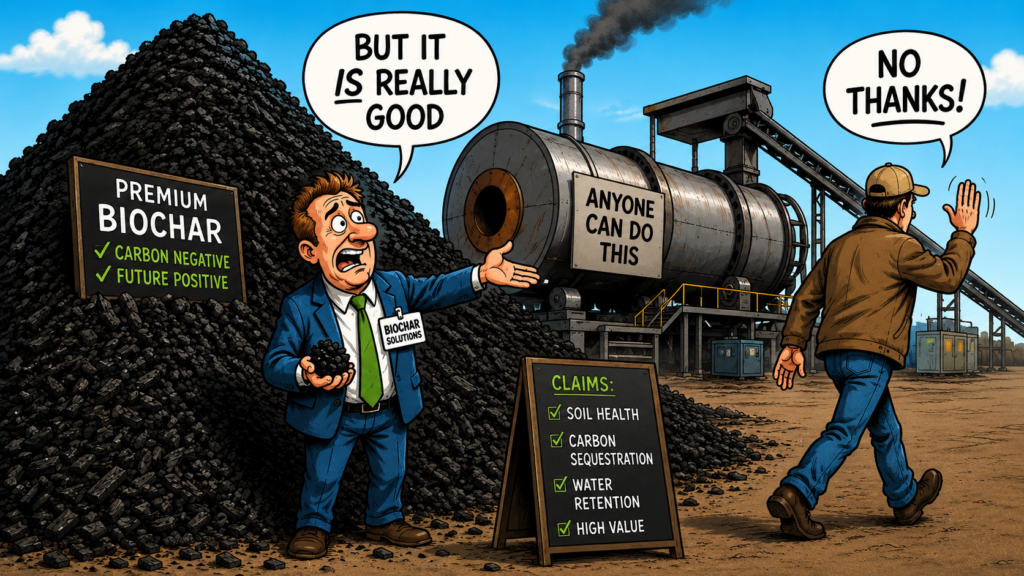
For every successful biochar company, dozens have failed. Many investors discover—far too late—that producing black carbon is easy. Producing a technically sound, commercially valuable biochar is incredibly difficult.
The problem isn’t that biochar doesn’t work. The problem is that most people don’t understand science that determines whether it works.
Here are four technical reasons many biochar ventures lose substantial amounts of money.
1. They Assume All Biochar Is the Same
This is perhaps the biggest mistake in the entire industry.
Biochar is not a product. It is an entire family of carbon materials whose properties change dramatically depending on how they are manufactured.
Consider these variables:
- Feedstock
- Moisture content
- Particle size
- Residence time
- Heating rate
- Oxygen concentration
- Peak temperature
- Cooling method
Changing just one variable can completely alter the finished product.
For example:
Biochar made from hardwood at 450°C behaves very differently than biochar made from rice husks at 750°C.
One may possess excellent cation exchange capacity.
The other may possess excellent silica content.
One may remove heavy metals.
The other may remove almost none.
One may dramatically improve soil biology.
The other may inhibit plant growth.
Many startups believe that once they’ve built a pyrolysis unit, they have entered the biochar business. In reality, they’ve merely begun making carbon.
Without understanding carbon chemistry, pore development, ash chemistry, and surface functionality, they have no consistent product to sell.
Customers quickly discover this inconsistency. Markets disappear. Investments evaporate.
901X biochar benefits @ only 6 months into development
- 8mg/g metals removal to 0 ppm
- Removal at 4-6 gpm/square ft
- Regenerable with 4 ppm Sodium Bicarb
- Low-Middle MW Molecule removal at 5x the rate as the best GAC
- 5 distinct and specific successful industrial applications w comparative data
2. They Ignore Surface Chemistry
Most discussions focus on surface area. Surface area is important, but surface chemistry is often far more important.
Two biochars can possess identical BET surface areas while performing completely differently in real-world applications.
Why?
Because adsorption depends on much more than pore volume. Surface chemistry determines:
- Electrical charge
- Functional groups
- Hydrophobicity
- Hydrophilicity
- Oxidation state
- Mineral attachment
- Catalytic activity
For example, removing PFAS, pharmaceuticals, pesticides, heavy metals, or dissolved organics requires entirely different surface characteristics.
Many companies advertise:
“Our biochar has 800 square meters per gram.” That sounds impressive but surface area alone tells almost nothing about performance. Activated carbon manufacturers have understood this for decades.
The same lesson applies to biochar.
Without engineering the carbon surface, adsorption efficiency may remain disappointingly low regardless of pore size.
This is one reason many laboratory successes fail once commercial production begins.
3. They Overlook Feedstock Variability
The phrase “waste biomass” sounds attractive. Unfortunately, waste biomass is rarely consistent.
Feedstock changes every season. It changes every harvest. It changes geographically. It even changes throughout the day.
Consider agricultural residues.
Corn stover harvested after a wet season differs chemically from corn stover harvested after a drought.
Wood chips from pine behave differently than oak.
Construction waste differs from forestry residue.
Rice husks contain large amounts of silica.
Peanut shells contain widely different mineral compositions.
Nut shells produce different pore structures than grasses.
Every change influences:
- Ash content
- Fixed carbon
- Volatile matter
- Mineral concentration
- Yield
- Strength
- Reactivity
- Electrical conductivity
The result is inconsistent product quality.
Customers purchasing filtration media expect repeatable performance.
Industrial buyers demand specifications.
Municipal water systems require certified consistency.
If each production batch behaves differently, quality assurance becomes nearly impossible.
This is why successful carbon manufacturers spend enormous effort standardizing raw materials before production even begins. Ignoring feedstock consistency creates technical problems that become expensive business problems.
4. They Build a Production Facility Before They Build a Market
Many biochar companies make a costly assumption: “If we build it, customers will come.”
History suggests otherwise.
Commercial success depends on solving specific customer problems.
Too many producers manufacture generic biochar first and search for applications later.
The reverse approach is much more successful.
Ask first:
- Does a customer need contaminant removal?
- Soil improvement?
- Animal feed additives?
- Stormwater treatment?
- Carbon sequestration?
- Battery materials?
- Hydrogen storage?
- Industrial filtration?
Each application requires a completely different carbon material.
A biochar optimized for soil improvement may perform poorly in water filtration.
A biochar designed for carbon sequestration may have little value for adsorption.
A filtration media may be unsuitable for agriculture because of pH or mineral content.
Without identifying the end market before production begins, companies often manufacture large inventories that satisfy no one particularly well. Warehouses begin filling. Cash flow slows.
Investors become impatient. Equipment payments continue.
Many companies fail not because their technology was poor—but because they built manufacturing capacity before validating commercial demand.
The Hidden Cost of Poor Technical Understanding
Biochar has become surrounded by enthusiasm. Unfortunately, enthusiasm cannot replace engineering.
Many investment presentations emphasize:
- Carbon credits
- ESG initiatives
- Climate change
- Circular economy
- Waste reduction
These are all legitimate opportunities, but to the customer they are features and not benefits. The first lesson we learn in sales is that a customer buys when he can see the benefits. Biochar CEOs create companies that offer the customer absolutely nothing.
Commercial buyers ultimately purchase performance.
Whether the application is agriculture, environmental remediation, water purification, or industrial processing, customers expect measurable results.
That requires understanding material science—not marketing.
The companies that succeed are rarely those producing the largest quantities of biochar.
Instead, they are the companies producing the most consistent, application-specific carbon materials.
The Future Belongs to Engineered Carbon
The next generation of biochar companies will likely look less like traditional charcoal manufacturers and more like advanced materials companies.
Success will increasingly depend on:
- Precise process control
- Feedstock standardization
- Surface chemistry engineering
- Product certification
- Performance validation
- Application-specific design
- Quality assurance
- Scientific testing
Biochar has enormous potential but realizing that potential requires far more than heating biomass in the absence of oxygen. It requires a deep understanding of chemistry, physics, materials science, and customer requirements.
Final Thoughts
Biochar is neither a miracle material nor a guaranteed investment. It is a sophisticated engineered carbon whose value depends entirely on how well it is designed for a specific application. Entrepreneurs who underestimate that complexity often discover that the economics are far less forgiving than the marketing brochures suggest.
The four technical mistakes outlined above—assuming all biochars are the same, ignoring surface chemistry, overlooking feedstock variability, and building production before validating a market—have contributed to the failure of numerous ventures. In nearly every case, the underlying issue is not a lack of demand for biochar itself, but a lack of understanding of the science that governs its performance.
The winners in the biochar industry will not necessarily be those who produce the most material. They will be those who consistently produce the right material. As markets mature and customers become more sophisticated, technical excellence, reproducibility, and application-specific engineering will increasingly separate profitable companies from those that simply produce another pile of carbon.