
A Reckoning We Cannot Afford to Ignore
Across the globe, a growing confrontation is taking shape between communities determined to protect their water supplies and an expanding, increasingly indispensable industry: AI and data centers.
I have not witnessed this level of public outrage over an industrial development since the Vietnam War protests. The stakes are enormous. How we manage this new industrial revolution will have consequences for generations. Get the decisions wrong, and some of the damage may be irreversible.
At the heart of this controversy are two fundamental problems.
1. The Wrong People Are Leading the Water Conversation
One of the most troubling aspects of the current debate is that many of the most visible community leaders and activists have little or no practical experience with industrial water systems.
Memphis is a good example.
Water concerns are being represented by volunteer organizations and well-intentioned university experts. Yet academic credentials and good intentions are not substitutes for hands-on experience designing, operating, and maintaining industrial process water systems.
Someone might argue, “But Tom, they have Ph.D.s.”
That’s fine. But having a doctorate does not automatically make someone qualified to engineer an industrial water system. By that logic, we should feel perfectly comfortable having a podiatrist perform our cardiac bypass surgery.
This problem isn’t limited to Memphis. Across America, communities are entering negotiations over enormously complicated industrial water projects without the technical representation necessary to protect their interests.
Advantage: Data Centers.
2. The Public Doesn’t Have the Technical Knowledge to Ask the Right Questions
Citizens frequently complain that major industrial projects are proposed without adequate information or public education.
I agree with them.
But here’s the problem: Without a basic understanding of industrial water treatment, there is no meaningful platform for the public to engage with the engineers designing these facilities.
Consider some of the questions that rarely make it into public discussions:
What are antiscalants, corrosion inhibitors, biocides, lubricants, and defoamers, and why are they used in cooling systems?
What happens to these chemicals when cooling water is discharged?
What is the potential for Legionella and other microorganisms to become airborne through cooling tower drift?
What do Langelier Saturation Index, Silt Density Index, cooling tower blowdown, ion exchange capacity, and reverse osmosis recovery actually mean?
These aren’t obscure academic subjects. They are basic industrial water engineering concepts.
If the public doesn’t understand these fundamentals, how can community representatives effectively negotiate with highly experienced data center design engineers?
Advantage: Data Centers.
Do Data Centers Use a Lot of Water?
It’s All Relative
If we are going to establish a productive relationship between communities and the data center industry, there are two seemingly contradictory truths we must understand:
Data centers use a lot of water.
Data centers do not use a lot of water.
Before you conclude that I’ve lost my mind, consider this.
Suppose someone offered you a guaranteed $10 million annual income for the rest of your life if you agreed to retire tomorrow. Would you accept?
I suspect the overwhelming majority of people would jump at the opportunity.
Ten million dollars a year? That’s an extraordinary amount of money!
Now, suppose I made the same offer to Elon Musk, Jeff Bezos, or Mark Zuckerberg. Do you think they would be equally impressed?
Probably not.
To one person, $10 million is a fortune. To another, it’s relatively insignificant.
So, is $10 million a lot of money?
Yes. And no.
Numbers have no meaningful context without comparison.
A 300-pound pumpkin is enormous. A 300-pound elephant is practically a lightweight.
Water consumption works the same way.
Whether a data center uses a lot of water depends on the size of the local water supply, its replenishment rate, existing demands, and the amount of water available for sustainable withdrawal.
We cannot simply declare that every data center represents a water crisis.
The right question isn’t how much water a data center uses. It’s how much that usage matters to the particular community where it operates.
Smart Decisions Versus Dumb Arguments
My hometown of Memphis, Tennessee, provides an interesting example of the disconnect between public perception and water engineering.
Residents and members of the academic community have expressed outrage over Elon Musk’s Colossus AI data center and its proposed use of approximately 1.3 million gallons of aquifer water per day.
Is that outrageous?
Let’s examine the relative numbers.
For years, Cargill Chemical reportedly pumped approximately 6 million gallons per day from the aquifer without an observed decline in its level.
Now, a proposed withdrawal of 1.3 million gallons per day is generating enormous controversy.
And there’s more. The aquifer extends across multiple states, and estimates of its total water storage have been reported as high as 100 trillion gallons.
At first glance, these numbers suggest that the proposed withdrawal is relatively small compared with the aquifer’s reported total storage.
But here’s an important distinction: Total aquifer storage is not the same thing as sustainably available water. Local groundwater levels, recharge rates, existing withdrawals, and hydraulic conditions must all be considered.
The concern over water consumption is legitimate. However, declaring a particular data center an existential threat without examining its actual impact on the local water resource is equally irresponsible.
Environmental decisions should be based on hydrology, engineering, and measurable consequences—not outrage.
Is Recycled Water Really The Answer?
Here we go again, using Memphis as an example. Sorry, Memphis!
There is a growing movement to require Colossus AI to use recycled wastewater rather than aquifer water in its cooling operations.
On the surface, this sounds like an obvious environmental victory. Why use valuable groundwater when wastewater can be recycled?
Unfortunately, the engineering isn’t quite that simple.
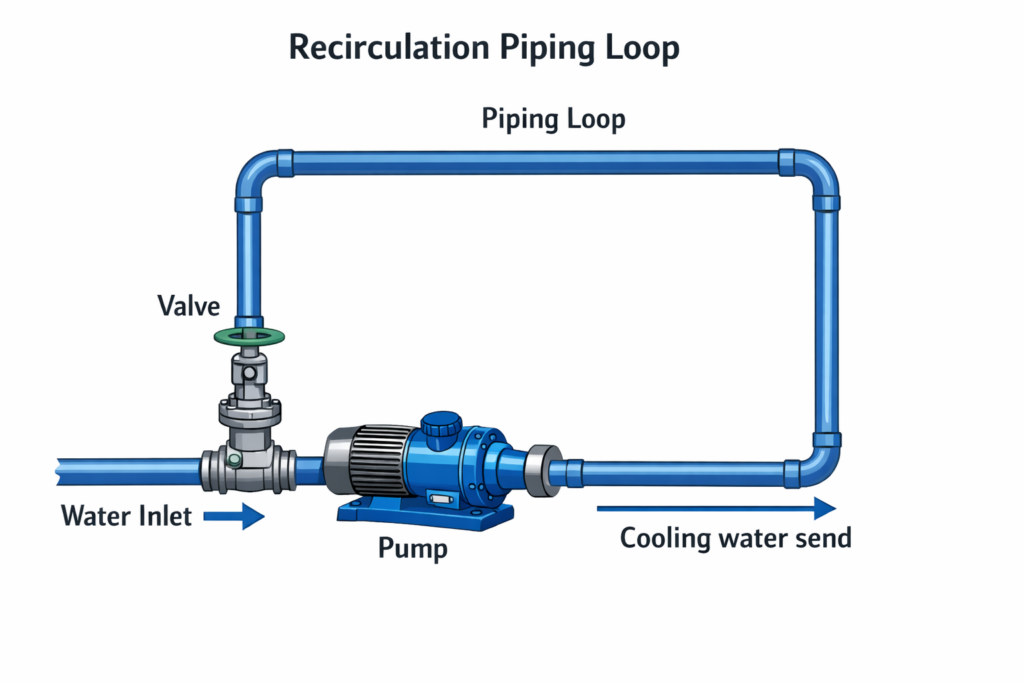
This is what the public visualizes when they hear the phrase, “closed loop cooling system”.
In this happy vision the data center fills the loop with gray water and it circulates forever, never to use local water and never to hurt the environment.
Unfortunately, closed loop cooling systems are not closed to the environment, and offer a lot of opportunities to contaminate the environment and make people sick.
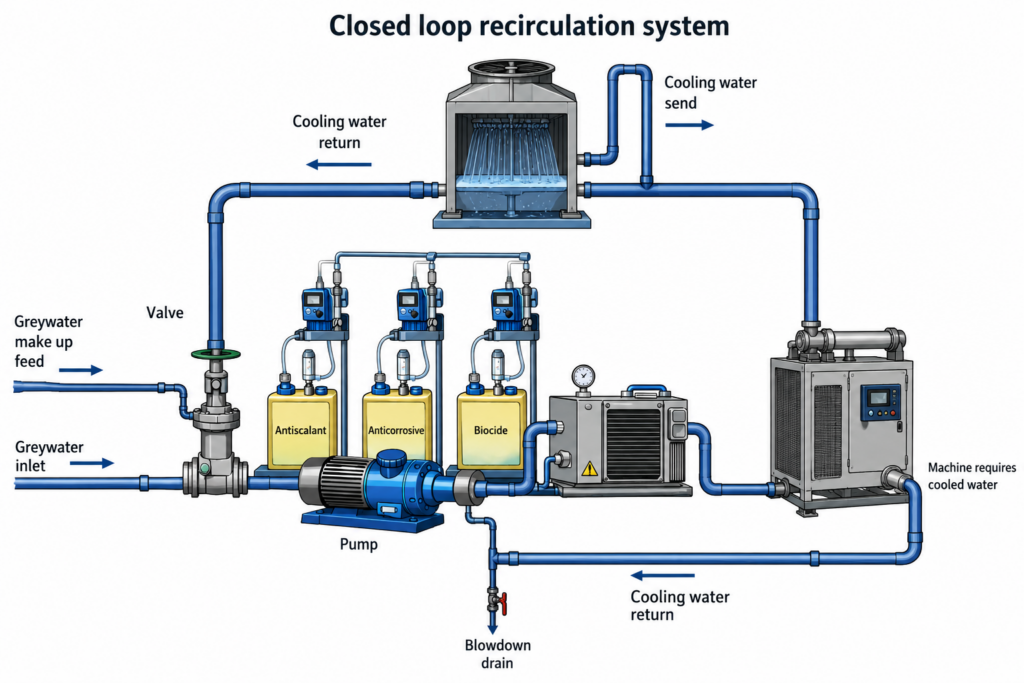
This is the real world vision of what a closed-loop cooling system looks like.
The system involves multiple chemical additions, blowdown of concentrated chemicals and debris into the local environment, and cooling tower evaporation that exposes the air to toxic contamination
Recycled wastewater can contain a complex mixture of dissolved minerals, salts, organic compounds, treatment residuals, and microorganisms. Its suitability for industrial cooling depends on its actual composition and the treatment required to make it usable.
To someone unfamiliar with industrial process water, substituting recycled water for drinking-quality water sounds like a no-brainer.
To someone who has spent decades designing industrial water systems, however, several red flags immediately appear.
A closed-loop cooling system is not necessarily isolated from the environment.
Three Potentially Serious Risks of Recycled Water in Cooling Systems
1. Chemical Concentration and Cooling Tower Blowdown
As water evaporates, dissolved minerals, chemicals, and other contaminants become increasingly concentrated.
Eventually, a portion of the circulating water must be discharged to control this concentration. This process is called blowdown.
Blowdown occurs whether the system uses fresh water or recycled wastewater.
However, when the incoming water has a high mineral and contaminant load, maintaining acceptable cooling water chemistry can become considerably more challenging.
This may require additional treatment chemicals and more frequent blowdown, depending on the system design and operating conditions.
The environmental implications deserve serious attention.
Some industrial chemicals, including certain fluorinated compounds, can present environmental concerns. Biocides can also be toxic to aquatic organisms.
Furthermore, conventional wastewater treatment plants were not necessarily designed to remove every emerging contaminant entering today’s industrial waste streams.
We should not assume that everything discharged into a municipal treatment system will automatically be removed.
2. Cooling Tower Aerosols and Airborne Microorganisms
This is an area that deserves far more public attention.
Cooling towers reject heat by bringing circulating water into contact with moving air. During this process, some water evaporates, while small droplets can escape as airborne drift.
Unlike pure water vapor, these droplets can carry dissolved substances and microorganisms.
One particularly concerning organism is Legionella, the bacterium responsible for Legionnaires’ disease.
Cooling towers have been associated with some of the largest outbreaks of this potentially fatal illness.
The distinction is important: The visible plume from a cooling tower is primarily water vapor. The concern is the smaller liquid droplets that can carry contaminants into the surrounding air.
Now consider the implications of introducing inadequately treated recycled wastewater into these systems.
Recycled wastewater does not automatically meet drinking-water microbiological standards. Its suitability depends on treatment, disinfection, monitoring, and system management.
Forcing a data center to use recycled water without carefully evaluating these risks, particularly near residential neighborhoods, is not responsible environmental stewardship.
3. Leaks and Accidental Releases
Every recirculating cooling system presents the possibility of leaks, equipment failures, and accidental releases.
The consequences depend on the water chemistry, the location of the leak, and the substances present.
When recycled wastewater is involved, the potential introduction of microorganisms, organic contaminants, and other undesirable substances deserves additional scrutiny.
These risks do not automatically make recycled water unsuitable. They do mean that system design, containment, monitoring, and emergency response must be taken seriously.
Environmental protection requires more than simply changing the source of the water.
At Least Recycled Water Won’t Waste Our Drinking Water. Right?
Once again, we need to look at relative numbers.
One of the most important water quality parameters in industrial cooling is Total Dissolved Solids, commonly called TDS.
TDS measures the concentration of dissolved substances, primarily minerals and ions, in water.
In general, the lower the TDS, the more effectively a cooling system can concentrate its circulating water before requiring blowdown.
This is important because fewer blowdown events can mean lower water consumption, reduced chemical requirements, and less wastewater discharge.
The data center industry has a legitimate reason to favor locations with naturally low-TDS water.
Consider Memphis. The TDS of Memphis water can be as low as approximately 40 parts per million (ppm). By comparison, a commonly cited U.S. drinking water average is approximately 275 ppm.
Now consider recycled wastewater.
Depending on its source and treatment, recycled wastewater can have TDS concentrations approaching 1,200 ppm or higher.
That’s a substantial difference.
A cooling system receiving high-TDS water may have to discharge water more frequently to maintain acceptable operating conditions.
Consequently, a facility using recycled wastewater may require more makeup water than an otherwise comparable system using low-TDS fresh water.
In some circumstances, using recycled wastewater can actually increase total water consumption rather than reduce it.
That doesn’t mean recycled water is a bad idea. It means the decision must be based on actual water chemistry and engineered performance.
Data Center Water: We Must Ask the Right Questions
The debate over whether data centers are necessary is largely academic at this point.
Medicine, the military, agriculture, manufacturing, environmental monitoring, telecommunications, the Internet, and virtually every aspect of modern life are already intertwined with digital technology.
Artificial intelligence is accelerating that dependence.
There is no realistic path backward. The competition for AI superiority is already a strategic, economic, and national security priority.
The question of whether data centers are good or bad is largely the wrong debate.
Instead, we should be asking much more meaningful questions:
Where are the appropriate locations for data centers based on available water resources?
What engineering standards and design improvements should communities demand?
What safeguards are necessary to protect groundwater, surface water, and surrounding neighborhoods?
How will cooling tower emissions, chemical usage, and wastewater discharges be monitored?
Who has the technical qualifications to represent communities when these projects are proposed?
These are the questions that matter.
Remember: It’s All About Relative Numbers.
A million gallons of water per day is an enormous amount for a small, water-stressed community.
In the context of the Great Lakes, however, that same withdrawal represents a very different scale of impact.
The Great Lakes contain approximately 6 quadrillion gallons of water.
To put that number into perspective, that’s 6 billion million gallons.
The point isn’t that water resources are limitless. They aren’t.
The point is that water consumption must be evaluated in the context of the resource being consumed, its replenishment, and the demands already placed upon it.
A water withdrawal that is irresponsible in one location may be entirely manageable in another.
The Future Doesn’t Have to Be a Tug of War
Environmental advocates want to protect water resources. Data center developers want to build facilities where their investments make economic sense.
Neither objective is inherently unreasonable.
The problem begins when environmental concerns are driven by incomplete technical information, or when developers prioritize economics without adequately addressing the legitimate concerns of the communities where they operate.
We cannot afford either extreme.
The answer isn’t to stop technological progress. Nor is it to give the data center industry a blank check.
The answer is competent engineering, responsible site selection, transparent disclosure, and technically qualified public representation.
After more than three decades working in the water industry, I’ve learned that most water problems have engineering solutions.
But engineering solutions require accurate information, realistic expectations, and people who understand the systems they are discussing.
If environmental advocates and the data center industry cannot get beyond the rhetoric and begin working together, our journey into the AI revolution will become a painful, never-ending tug of war. And in the end, we will all lose.
Water is too important. Technology is too important. Getting this right is not optional.
When Technology Meets Water Scarcity